Anthology Announcement

We interrupt this series of anthology teasers to let you know that Every Second Tuesday is now available to buy from Readings, our hosts for the launch on 9 December. You can get your copy of the book here. Quick, before they sell out!

If you happen to be in Melbourne, you could visit the St Kilda branch of Readings to pick up a copy. But give them a call first to reserve one.

If ebooks are your preferred way to get your literary hit, then head to your favourite ebook retailer for a copy.

We can now return to our regular programming.

Thanks for reading.

Elwood Writers

Teasers

In the run up to the launch of Every Second Tuesday on Wednesday 9 December, each member of Elwood Writers will be introducing one of their pieces from the anthology. These teasers will appear on the Elwood Writers website, so if you’re not already following the blog and want to be sure of seeing every post, press the ‘follow’ button on the home page, here.

A reminder that our launch event will be online through Readings. To ensure you receive the link on the day, please register here. As it’s an online event, there are no geographical barriers to attending. The event is free, and the only requirement is an internet connection. And should the time difference be prohibitive, book a ticket anyway as the event will be recorded and a link to the video sent to all registered participants, whether they attend on the day or not.

So keep your eyes peeled for our anthology teasers over the next couple of weeks. Coming up shortly, Jennifer Bryce will talk about her short story ‘Duets’.

Stay tuned!

Book Launch Invitation

We are delighted to have the Elwood Writers group – Jennifer Bryce, Margaret McCaffrey, Helen McDonald and Barry Lee Thompson – join us online to discuss Every Second Tuesday. A new anthology of poetry, fiction and memoir, this kaleidoscope of stories spans the globe from the trenches of France in World War One to a dystopian Australia, via contemporary Harlem and the streets of northern England. The Elwood Writers will chat about their book and their group with award-winning local author Lee Kofman.

Elwood Writers in conversation | Wed 9 Dec 2020 at 6:30pm

from the Readings events page

It’s coming! Our anthology Every Second Tuesday is about to hit the shelves, and we’d love you to join us online as Lee Kofman launches the book with Readings on Wednesday 9 December at 6:30pm (AEST). This is a free event, though booking is required in order to receive the meeting link on the day of the event.

Every Second Tuesday | Stories by Elwood Writers

As it’s an online event, geography is no bar to attending. There are no limits to how many people can come along, so feel free to share this invitation far and wide. And if you’re unable to make it on the day, book a ticket anyway to automatically receive a recording to watch at your leisure.

Here’s the event details again: Elwood Writers in conversation | Wed 9 Dec 2020 at 6:30pm. Booking info is on that page, or this link takes you straight to the booking page. It’s free, and it’s online.

So wherever in the world you might be, we hope you’re able to celebrate with us in some way. We guarantee it’ll be a night to remember.

Every Second Tuesday, update

The publication of Every Second Tuesday, an anthology of our writing from over the last ten years, is being held back until early November. By that time we anticipate seeing a little more stability in the literary landscape as new and exciting models of delivery are embraced.

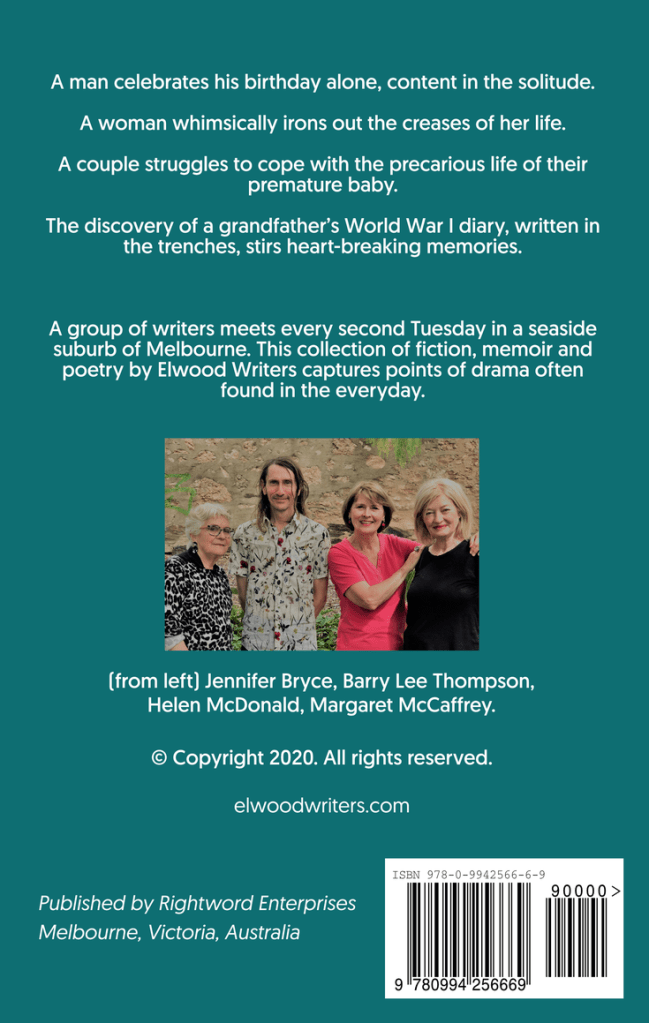
In the meantime, here’s a peek at the book’s back cover:

And before the anthology arrives, we have the release of Barry’s collection of fiction to look forward to. Broken Rules and Other Stories is coming out on 1 September. More information is available at the Transit Lounge website, here.

So please stay tuned – there’s a lot happening this year, and we’ll be providing plenty more updates along the way.

Happy reading and writing.

‘Every Second Tuesday’ is coming

We may have been in lockdown for a few months but Elwood Writers has been busily putting the finishing touches to a project we’ve been working on over the past two years. We’re currently checking printed proof copies of Every Second Tuesday, an anthology of our writing drawn from over the last ten years.

Now we’re excited to share news of the anthology’s forthcoming publication in both paperback and ebook forms. We’ll keep you posted …

Jewels of San Fedele

Margaret is pleased to be a contributor to the anthology ‘Jewels of San Fedele’, which comprises the work of 14 women who attended a writing retreat in Italy, 2016. The ‘experiential’ classes were designed to have students deepen their work. Margaret’s two stories are excerpts from a memoir in progress.

‘Jewels of San Fedele’ is edited by D Ferrara and Patricia Florio, and is available from Amazon at the following link:

Helen’s Impressions of Adelaide Writers’ Week 2017

Once again Adelaide delighted with its heady mix of festival fare. Writers from round the world took to the stage in the wonderfully situated Pioneer Women’s Memorial Gardens by the river. This year I was drawn to the writings of the chroniclers of our times – the journalists and social commentators who strive to show us the truth of complex human situations through both non-fiction and fiction. A highlight was the poetry reading session curated by Peter Goldsworthy, with six of Adelaide’s noted poets reading from their collections. I particularly loved the simplicity of Jules Leigh Koch’s and Cath Kenneally’s readings. Their observations on the small, often suburban details of life can be both profound and poignant. Leigh Koch’s Man in the Bookshop ‘tucks his thoughts away like a bookmark’ while one of Kenneally’s characters is ‘leaking at the seams’.

In US journalist Thomas Frank’s ‘Listen Liberal’ he explores the failings of the US left and the disintegration of the middle class. He believes the Democrats cannot find the policy or conviction to alter the economy and ‘the gravity of discontent keeps pulling to the right, and the right and the right’. Ben Ehrenreich and Mei Fong, respectively writing about the lives of Palestinians living in the West Bank in ‘The Way to the Spring’ and the effect of China’s one-child policy in ‘One Child’, discussed the very real issue of bias and objectivity in telling compelling stories. Ehrenreich posed the question: How can you write about Palestine objectively when it is very clear there is an absolute imbalance of power? You cannot denude the truth, he purports, and you must be transparent about where you stand. Fong concurred that the reader wants to know the truth and you must give your reader a clear point of view. Of course bias is in her book by her very status of being Chinese and a woman.

Journalists Patrick Cockburn (Ireland), ‘The Rise of Islamic State’, and Janine di Giovanni (US), ‘The Morning They Came for Us’, both Middle Eastern experts, gave a sobering and thorough account of the chaos that is Syria, painting a clear picture of the major players involved and the likely outcome. On the other hand, two novelists have brought the stories of the marginalised to readers via fiction. Mexican author Yuri Herrera, ‘Signs Preceding the End of the world’, and Korean Krys Lee, ‘How I Became a North Korean’, explore the realities of displaced people. Herrera delves into the shadowy world of border communities where people are not ‘recognisable’ (no papers or passports) and must adapt to many migrants from different worlds living together. He deems ‘art allows us not to be hostage to one version of reality’. Lee wanted to write about the people she knows who are not just ‘North Korean’, but complex human beings. How do we know what it is like to be that person who is simply a stereotype to the outside world? she asks.

I enjoyed an entertaining session on Books and Reading with Keith Houston (Scotland), an expert on the history of the book, and Alberto Manguel (Canada) who has written extensively on books and reading. It was heartening to hear both authors emphatically stating that the book will survive, that libraries are our identity and memory, and can and must collect everything, including new technologies.  Libraries must be preserved, they concurred!

Of course there was so much to sample of the Arts and Fringe festivals running concurrently. Watching the Berlin company Schaubuhne Berlin’s rendering of Shakespeare’s Richard III in German was a roller coaster of frenetic-paced, fantastic acting, to the accompaniment of heavy metal music, rapping, and with audience interaction and nudity (his) on stage. A phenomenal performance and for this writer quite thrilling as Richard limped off the stage, plonked himself next to me at the end of the row and asked ‘Do you mind?’ as Anne delivered her soliloquy over her dead husband’s body.  No proscenium arch here!

Finally, as part of the Fringe Festival, a delightful concert of popular music by The String Family, mum, dad and two teens all on cellos or violins, had everyone’s toes tapping.  Their story of life on the road for the past thirteen months, travelling around Australia, living in a caravan and winning the Australian National Busking Championship, had moments of great poignancy as they live out ‘the dream’. While missing the family and friends they have left behind, they have come to understand, first hand, the hardships of life on the land for so many Australians. Now there’s a book in that.

Jennifer’s Impressions of Adelaide Writers’ Week 2017

What will I take away this year from Adelaide Writers’ Week? One of the visiting writers, Ian McGuire, when asked why he writes, quoted John Cheever: ‘I write as a way of making sense of my life’. Yes, I thought, that’s what I try to do.

I spent quite a lot of time not attending the talks on the banks of the River Torrens. It seemed better to savour a few things than to come away crammed with a confusion of wisdom. This allowed time to attend some of the concurrently running Adelaide Festival: plays, concerts and two excellent interviews/panel discussions on The Secret River and Richard III, conducted by David Marr.

Adelaide writers week

I attended (and years ago had read) Kate Grenville’s The Secret River, I had recently read Hannah Kent’s The Good People and Zoë Morrison’s Music and Freedom and I have become particularly interested in how writers might use a little-known historical incident as the starting-point for a piece of fiction – most of the sessions I attended related to this interest.

Armando Lucas Correa uses the story of the ship, St Louis, which, just before World War II transported Jewish families from Nazi journey to find a safe haven. But they were turned away from Cuba, Correa’s home country, from New York – with its vibrant Jewish community – and other places, to have to return to Europe, to countries such as the Netherlands, which were later occupied. Many of those Jewish families seeking asylum ended up in Nazi concentration camps. Correa has created a young girl on that ship, who happens to be the same age as his own daughter, and he tells the story of those families through the eyes of the young fictitious Hannah.

Glaswegian Graeme Macrae Burnet found intriguing documents when he was researching his family history: medical reports and court transcripts of a murder trial in 1869. A seventeen-year-old youth wrote a lucid confession to three violent crimes. Why?  The context is a remote crofting community where stoicism and violence may have been the only way to respond to feudal conditions and grinding poverty. One of the characters sums up what is explored in Macrae Burnet’s book: ‘One man can no more see into the mind of another than he can see inside a stone’. The book, His Bloody Project, was short listed for the Man Booker award.

Hannah Kent found a short newspaper article one day when she was undertaking some other research. In the early 19th century, in Ireland, a woman was tried but ultimately pardoned for a drowning murder because she believed that she was dealing with a changeling – a child brought by the fairies and substituted for another child. This led to Kent’s book, The Good People. Kent spent 6 weeks in Ireland, going to the place where her story is set, walking through the muddy fields, learning some of the expressions used in the isolated communities of that time. From a brief newspaper article a vivid depiction has unfolded of a life governed not only by faith in God but, with poverty so grim that a doctor can’t be afforded, with spirits and superstition.

Ian McGuire studied the journals of surgeons on whaling ships to inform his book about mid 19th century whaling in the Arctic region, The North Water. The book is a thriller, but not a ‘whodunnit’—we know from the first chapter that Henry Drax committed murder. There is an abundance of smells, suggesting that Drax is like an animal, moving through a world of smells as animals do. He is also animal-like in that he lives in the present moment, with no sense of consequences. McGuire grew up in Hull, where the book is set – it has changed greatly since those whaling days, but his familiarity with the town helped him to recreate it in an early 19th century context.

Although it is set in the past, the interviewer did not dwell on this aspect of Zoë Morrison’s Music and Freedom. There was greater interest in her treatment of domestic violence, which indeed is a central theme of her book. Zoë said that her main character ‘just appeared on the page’ one day when she was doing a writing exercise. Presumably her vivid accounts of performing a Rachmaninov concerto come from personal experience, as Zoë is an accomplished pianist.

ZM-cover-600px-x2.jpg

Two other sessions that I particularly enjoyed were Caroline Baum’s discussion of her recently published memoir, Only, and Paula Byrne’s discussion of research into the life of Jane Austen. Caroline, an experienced journalist, mentioned how refreshing she finds it to write in the first person – something that is pretty much taboo for journalistic reporting. I was hooked when she read from her prologue, using the metaphor of a triangle as the situation of an only child – there are pointy ends, things don’t mesh together. Caroline mentioned that a life of privilege can in many ways be a handicap for a writer. Now she has had to tackle the fact that her mother doesn’t agree with all that she’s written, and grapple with the possible fallacy of memory – we think we remember something accurately – but is it accurate?

Paula Byrne has written several biographies of Jane Austen. From her talk I got further insight into Austen’s genius. Byrne said, ‘nothing Jane Austen does is an accident’. For example, the way characters play the piano has a purpose. The Real Jane Austen is organised around objects: each chapter begins by focusing on an object, such as a cashmere shawl. Byrne stressed that as a young woman Jane Austen was playful and naughty – not the demure young lady that the Victorians described, and Byrne emphasised Jane Austen’s independence and feminism – her female characters think for themselves, they don’t defer to men. Byrne is sure that Jane Austen could have married – in fact she turned down one poor man pretty much on the day of the wedding. She may have been anxious about childbirth, or she may have realised that as a married woman she would have less freedom to write.

Elizabeth Harrower

Something quite different, though, was the opportunity to hear Elizabeth Harrower. How exciting that today we could see this 89-year-old writer, right there on the stage in Adelaide, and feel connection with the Australian literary canon. Harrower had attended the first Adelaide Writers’ Week in 1960. She used to have long phone conversations with Patrick White! She is a survivor of the generation of Patrick White and Christina Stead. Being there reminded me of musicians who, through their venerable teachers, have links to Liszt or Beethoven. After tremendous success as a young writer in the 1950s and ’60s, Harrower stopped writing when a manuscript was rejected by a publisher – she locked it away in a library and it was retrieved only recently by Michael Heyward of Text Publishing, who was her sensitive and intelligent interviewer on this occasion. In some ways we writers of today may feel that things were easier in the 1960s with so much less competition, but there also wasn’t support. It seems that back then there was no one to tell Elizabeth that she was right to think her writing good and that she should have persisted and not given up with the ‘rejection’. Fortunately, Text Publishing came along 50 years later.