Writing Process: Barry

I visit my writing several times throughout the day. Sessions vary from five minute bursts to extended periods of a few hours. This way, I can put in a minimum of a couple of hours a day, and often more like four to five. This is a framework. I have a home workspace – a place for my computer, books and tools – but can work anywhere.

Writing isn’t just a physical process of working with words on a page. It’s the creative and percolative activity that goes on in the spaces. In other words, the work also happens while reading, daydreaming, riding the bike, poking around, or what-have-you.

I’m never without a paper notebook. I keep the old ones stored in a filing cabinet. Captured moments. Conversations, song lyrics, glances, peripheral observations. The unorthodox, discordant, and mundane. Here, an obsessive mind might be a fortunate trait.

Short fiction suits my temperament and way of working. A new story can begin from a blank page, or a paragraph or phrase within an existing piece of writing. I rarely delete. An opportunity arises, such as a competition or a callout for submissions, and I circle round until I land on a fragment of material that captures my interest, and then begin to shape it into a new piece. Experimentation is thrilling, and I love the idea of development through failure. It’s a playful process, and instinct plays a part. Sentences are the building blocks of a story, and proficiency in them gives a reader confidence that they’re in capable hands, so allowing greater experimentation within the work.

Reading aloud, and listening to playbacks, I imagine works as radio pieces. Listening enables an objective sentence by sentence edit, and a chance to gauge the texture, mood, rhythms and poetry of the prose.

Writing can help to make life navigable. Anxieties, uncertainties and ambiguities can be contained and explored on the page through the endless possibilities of fictional forms.

Barry’s Adelaide reflections

coffee-adelaideThe festival experience in Adelaide becomes richer with each visit. This year, I felt an initial restlessness during the events. I wanted to be away from the authors talking about their work, and to get in front of my own writing. To put my hands inside my manuscript and pull the guts out of it. To lay it all out, examine it closely, and put it back together again. This reaction, far from a complaint, is rather desirable. I’m travelling to Ubud next week to work on my manuscript, and I can be confident the trip will be one of industry and production.
A highlight of Writers’ Week: The Crow on Wednesday morning at the west stage. Max Porter, author of Grief Is The Thing With Feathers, converses with Jonathan Bate about the life and work of Ted Hughes. In the soothing dapples of soft early sunlight we listen, rapt, to the disembodied voice of Hughes reading his work aloud in Adelaide forty years ago. Eerie and beautiful, this presence of the poet. Afterwards, I decide that I want this to be the taste that stays with me, and so leave the garden setting for the final time this year.

A similarly affecting experience on Thursday at the Art Gallery. A series of photographic images by William Yang chronicles his friend Allan’s demise from AIDS between 1988 and 1990. Each image is accompanied by Yang’s handwritten narrative. An unexpected punch arrives with the final photograph, of Allan in 1980. His vibrant and healthful face stares out. Ten years later, he’d be dead. Grateful to be alone, I search the image for a long time, looking for some communication between it and the fate of its subject.

The poignancy of Yang’s work is sharpened by the shade of an incident a few days’ earlier in the dorm at the youth hostel. Vivid anti-gay sentiments were a valuable reminder that we can’t be complacent; that, despite whatever ultimately happens with marriage equality in Australia, fear translates into hate in some minds. The hostel interaction is, however, a timely gift, prompting me to consider my short-story collection in a stark and vigorous light. Now on to Indonesia. There’s work to do.

Helen’s Reflections on Adelaide Writers’ Week

Adelaide Writers' Week.jpg

Looking back I barely dipped into the rich lucky dip of writers and their works on offer at this year’s Adelaide Writers’ Week. A smorgasbord of talent on offer, it was hard to pick and choose which sessions to attend.  Fortunately everything will be up on podcast within a week, so I can listen to my heart’s content to those authors I missed.

I had the sensation that bees were coursing through my veins, such was the level of excitement around the Festival hubs.  My creativity leapt and each night I lay in bed with thoughts and ideas sparking randomly and uncontrollably.  In short, I was beside myself.

I took a lot of notes so that, in the words of Australian poet Chris Wallace-Crabbe, the ‘immortal words’ I heard would not prove to be mortal.  I wished I’d seen more.  In the written expression of the human condition I learnt from New Zealanders Kate De Goldi and Fiona Farrell how it is to survive a devastating earthquake and record those experiences in both fiction and non-fiction forms.  Hyeonseo Lee took me on her journey as a defector from North Korea’s strange cult of the ‘Dear Leaders’, into hostile China and finally South Korea, where her welcome was not as warm as she might have anticipated.  Her perspective was fascinating to me as I lived in South Korea for four years in the 1980’s and had stared across the impregnable 59th parallel into a North Korean mock village, its communist soldiers bizarrely laughing and pointing at us.

French novelist Muriel Barbery – ‘The Life of Elves’ – is exploring a deeper understanding of her life, as she tries to live it more slowly as she ages.  It was heartening for this slow writer to know she has taken eight years to write this, her second book.  It’s OK to take time!  I loved her sense that the novel is ‘more intelligent than you’, taking on its own life while she writes.

Annabel Crabb and Jane Caro entertained with their wit and quips while American Jim Shepard inspired with his extensive research into the voices of Polish children in the 20th century for his latest novel ‘The Book of Aron.”  New Zealand’s first Poet Laureate, Bill Manhire, advised us to write what we don’t know.  How encouraging to hear inspiration is what happens when he’s NOT working.  First time UK novelist Max Porter thrilled with his readings from ‘Grief is the Thing with Feathers”.  In the same session (recorded for ABC Radio National) Oxford English literature Professor Jonathan Bate’s erudite reflections on  the life and work of poet Ted Hughes was dramatically enhanced by original recordings of the poet reciting his work at the Adelaide Writers’ Week forty years ago.  It was haunting.

Chris Wallace-Crabbe, a national treasure, uses all language in his poetry, mixing linguistic styles, the professorial with the profane – and he travels without Gods.  Nothing is unavailable and he believes lyric poetry turns sound into language.

I took away the message from Max Porter that nothing should get in the way of the reader.  There should be no connection between the lived experience of the writer and the word.

But most of all it made me want to write!

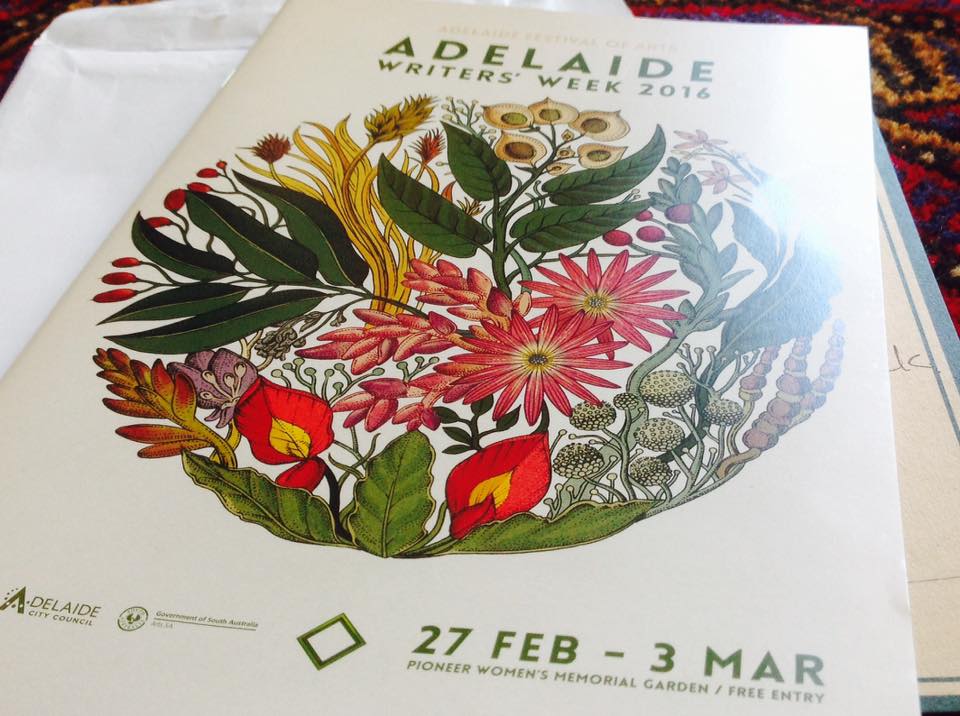
ADELAIDE WRITERS’ WEEK 27th FEBRUARY – 3rd MARCH 2016

12733441_561555817343430_4628818046112760300_nElwood Writers will be visiting Adelaide for Writers’ Week, held in the Pioneer Women’s Memorial Garden near the banks of the Torrens River. Part of the Adelaide Festival Of Arts, there will be sessions with international and local writers on topics as varied as Kerry O’Brien’s biography of Paul Keating, and Robert Dessaix talking about how Enid Blyton changed his life.

This will be the second occasion the group has visited this event together. We meet each morning for breakfast to mull over the program and spend some time workshopping our own writing. The event is a good opportunity to mix with other writers, readers and artists in a stimulating and creative environment.

Look out for more posts about our impressions of this event in the weeks to come.

#ADLWW

ON THE RADIO

One of Vision Australia Radio’s Cover To Cover programs in January 2015 entirely featured material produced by the Elwood Writers. The program’s theme was ‘Starting Over’ and it was re-broadcast on 31 December as one in a Best Of Cover To Cover series.

We are currently developing material for a Cover To Cover program for Mother’s Day in May this year.

VAR programs are now also broadcast in Perth.