Blog posts

Poetry for Public Transport

Elwood Writers’ Helen is published in Poetry for Public Transport #27. Poetry for Public Transport is a regular publication that makes poetry easily available to the many passengers travelling each day on our public transportation systems.

What a wonderful way to spend your journey: reading and contemplating a poem or two while on the bus, tram, train, ferry, or whatever form of transportation you choose to get around. Pop your smartphone away, unplug from social media, and arrive at your destination calm and refreshed. Or maybe you’ll be inspired to seek adventure, go right past your intended stop, and see where the day takes you.

This is an initiative well worth supporting, so if you spy a copy of the publication, please pick it up and read it, then share with your friends, colleagues, and other loved ones.

Poetry for Public Transport #27 | Please do not litter. Recycle.

My book launch

Elwood Writers’ Jennifer Bryce celebrated the official launch of her novel “Lily Campbell’s Secret” at Readings Books in Carlton earlier this week. Here’s her report on the event, from her website:

Jennifer Bryce's avatarlittlesmackerel

For me, the most exciting part of publishing my book was to see it there, bound, in a cover — a real book, rather than a word file or a heap of pages spewing all over the floor from my printer.

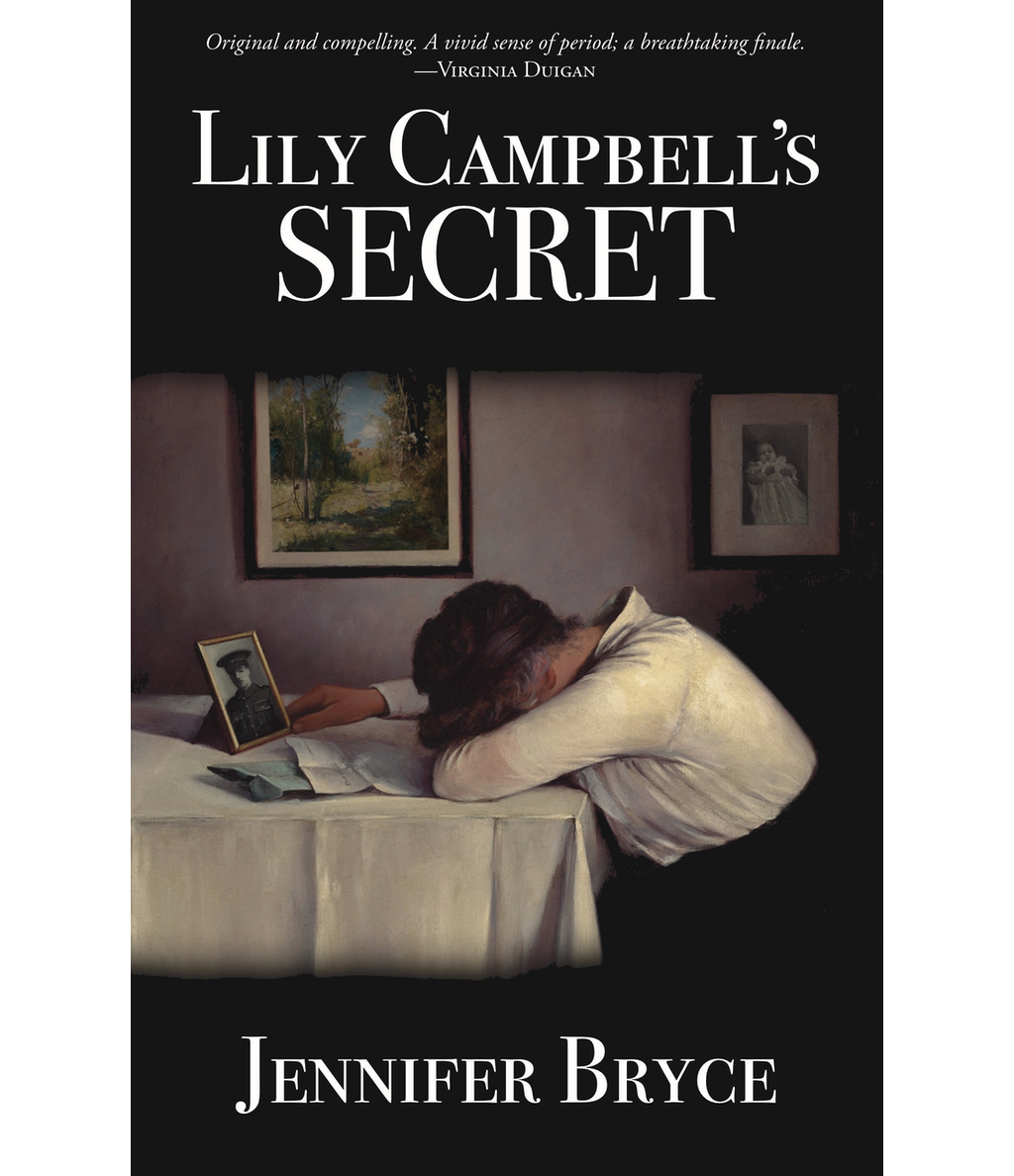
Sorrowing woman leaning on table in front of photo of her husband

But the next most exciting experience was last night, at Readings Bookshop, Carlton, where Toni Jordan launched it. Toni has a huge deadline to meet in a couple of weeks’ time, yet she had spent time thoroughly reading Lily Campbell’s Secret and looking back to her notes, to the time, in 2015, when I took her workshop, Refining Your Novel. I had naively thought that my carefully drafted novel was ready for refining! No way. It went through several iterations, but after the workshop with Toni it gained direction and purpose.

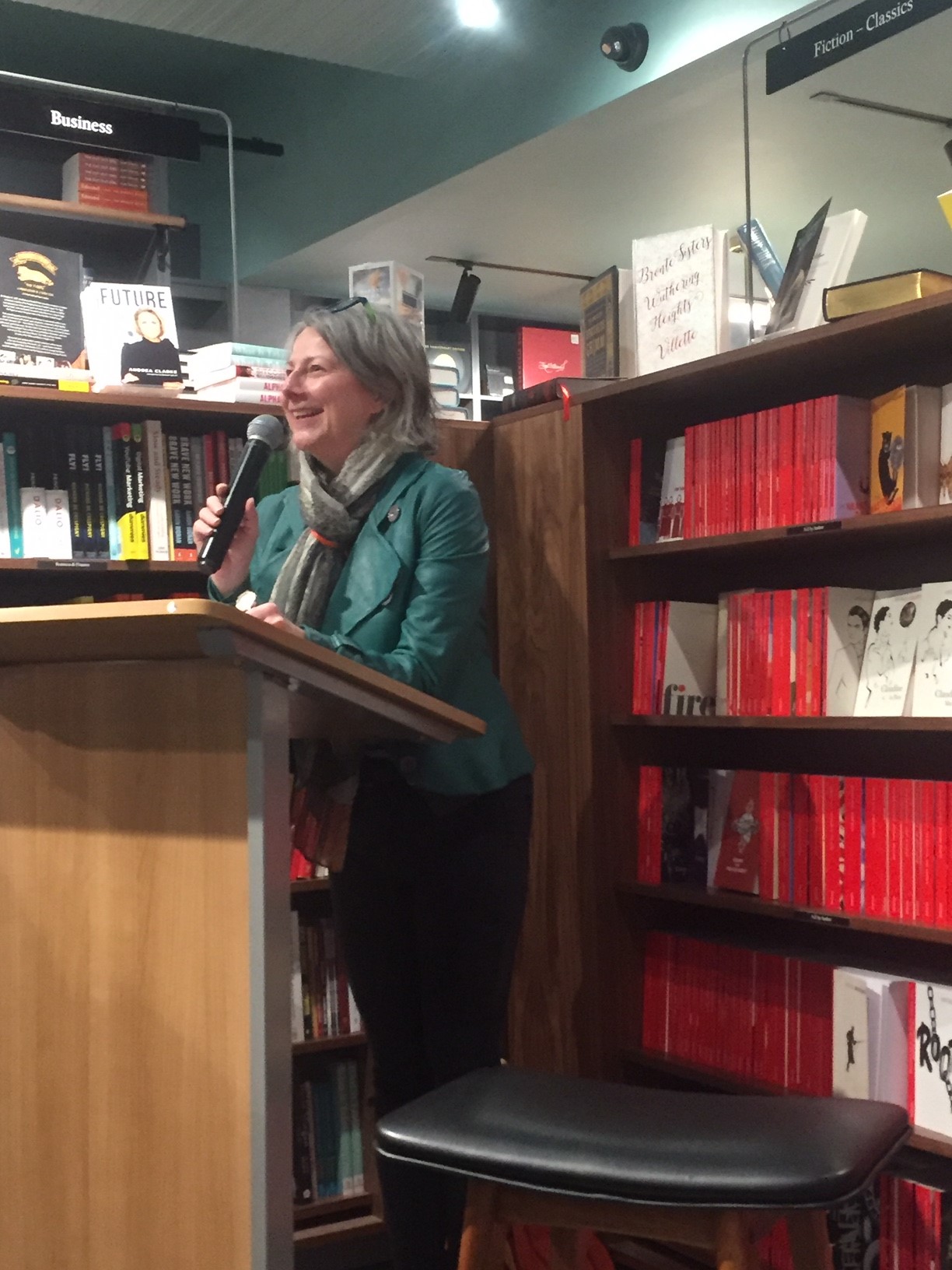
IMG_0929 (1).jpg

Toni Jordan launching Lily Campbell’s Secret

Barry Lee Thompson, from my writing group, Elwood Writers Elwoodwriters.com gave a…

View original post 183 more words

Book launch: American Writers Review 2019

Speaking of book launches …

The day after the launch of Lily Campbell’s Secret, way across the globe in Pennsylvania, San Fedele Press will celebrate the release of American Writers Review 2019 with an ice-cream social at Wilkes University.

If only Elwood Writers could go along to this. Not just because we adore a good old ice-cream social, but because three of our writers have work included in this terrific anthology. More about that later. Congratulations to Margaret, Helen, and Barry, and to all of the other contributors in this latest edition of AWR.

Friday 14 June, Wilkes University, Henry Student Center Ballroom (2nd floor), 7:30pm for readings, mingling, and ice-cream.

Release of Jennifer Bryce’s novel, Lily Campbell’s Secret.

Congratulations to Elwood Writer Jennifer Bryce on the publication of her first novel, Lily Campbell’s Secret. Jennifer’s book will be launched by Toni Jordan at Readings Bookshop in Carlton, details below. We’re looking forward to celebrating!

Jennifer Bryce's avatarlittlesmackerel

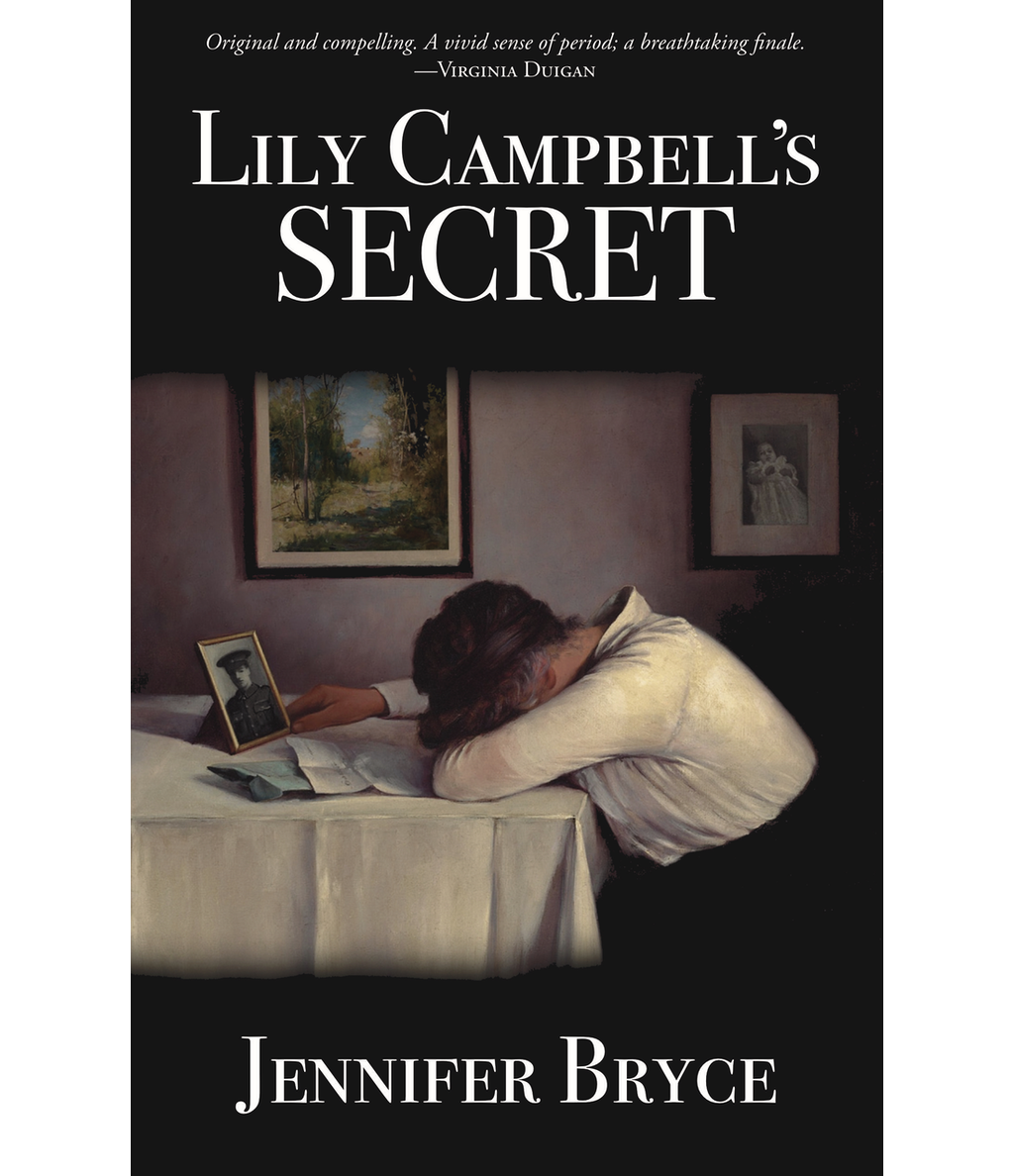
Sorrowing woman leaning on table in front of photo of her husband

It’s 1913, and Lily’s comfortable middle-class Melbourne life is completely upended when she falls in love. As she sits in the hall of her private school, portraits of past headmistresses frowning at her, she realises the ‘glaring, unalterable fact’ that she is pregnant, the father a young stablehand called Bert. Her parents disown her: the first of many wrenching challenges she must face. She marries Bert and they have a few happy months together in rural Woodend, where their daughter is born. When the war starts, Bert volunteers and Lily is thrown very much on her own resources. After Bert returns home, Lily has to face the most momentous decision of her life.

Lily’s role as mother, musician, wife and lover, leads her to confront issues of patriarchy, nationalism, love… and the value of a human life.

In Jennifer Bryce’s ‘Australian Gothic’ novel, the suppressed grand passions of her long-suffering…

View original post 106 more words

Where Do You Write? | Margaret McCaffrey

My local café recently changed its seating arrangement. Oh no. Not because of me, I hoped. Me, sitting at the big table by the front window, trying not to spread my papers and books about too much, but wanting to get my work done.

Under the new configuration I was forced to sit at a table for two, allowing barely enough room for my ‘stuff’. But it’s a lovely café and I determined to make do. It has been a godsend to me as I go through the latest phase of ‘where-I-work’.

When I first took up writing, I rented a small room in the CBD. Having just finished working, I couldn’t imagine not going into the city every day. But soon, it dawned on me that I couldn’t catch the tram in my dressing gown, which is what I wanted to do. Plus the office rent kept going up.

Next, I settled for working at home. Some days I barely moved from my bed. I began the day by journaling and went straight from there into writing. Tessa, our dog, patiently sighed at the end of the bed looking up every now and again in wait for her walk.

Natalie Goldberg is an author who says she loves Paris because there you can write in the cafés. I’m not sure this is still the case. But the message is, if you like a café and feel welcome there – anywhere in the world – then make the most of it.

People will tell you where to write, what your office set-up should be, how things should look and so forth. But I say: create a space that’s right for you.

Update: I visited my local favourite café last week. The long table had been returned to the front. Order had been restored. I know my secret, quiet, little coffee shop will not remain so forever. But while it lasts, I plan to write and luxuriate as much as I can.

Poetry and Place

How do we write?  And, importantly, where do we write?  Each of the Elwood Writers has their own method, quirky or disciplined.  Some are methodical, setting aside regular precious hours to pen papers, while others wait for inspiration to strike and write ‘off the hoof’ – and that would be me.  I find Place particularly important – ideas and images come randomly; when I’m out walking, in the middle of a busy cafe, or regularly at 4 am.  It’s handy to have a notebook or even a smartphone to capture those fleeting thoughts.  It can be a chaotic process.

I write poetry and have just returned from a wonderful, enriching two weeks in Japan, the spiritual home of haiku.  Never was a sense of place more powerful to me than being in the land of the rising sun during both Sakura – the spring cherry blossom season – and the last of the winter snowfalls.

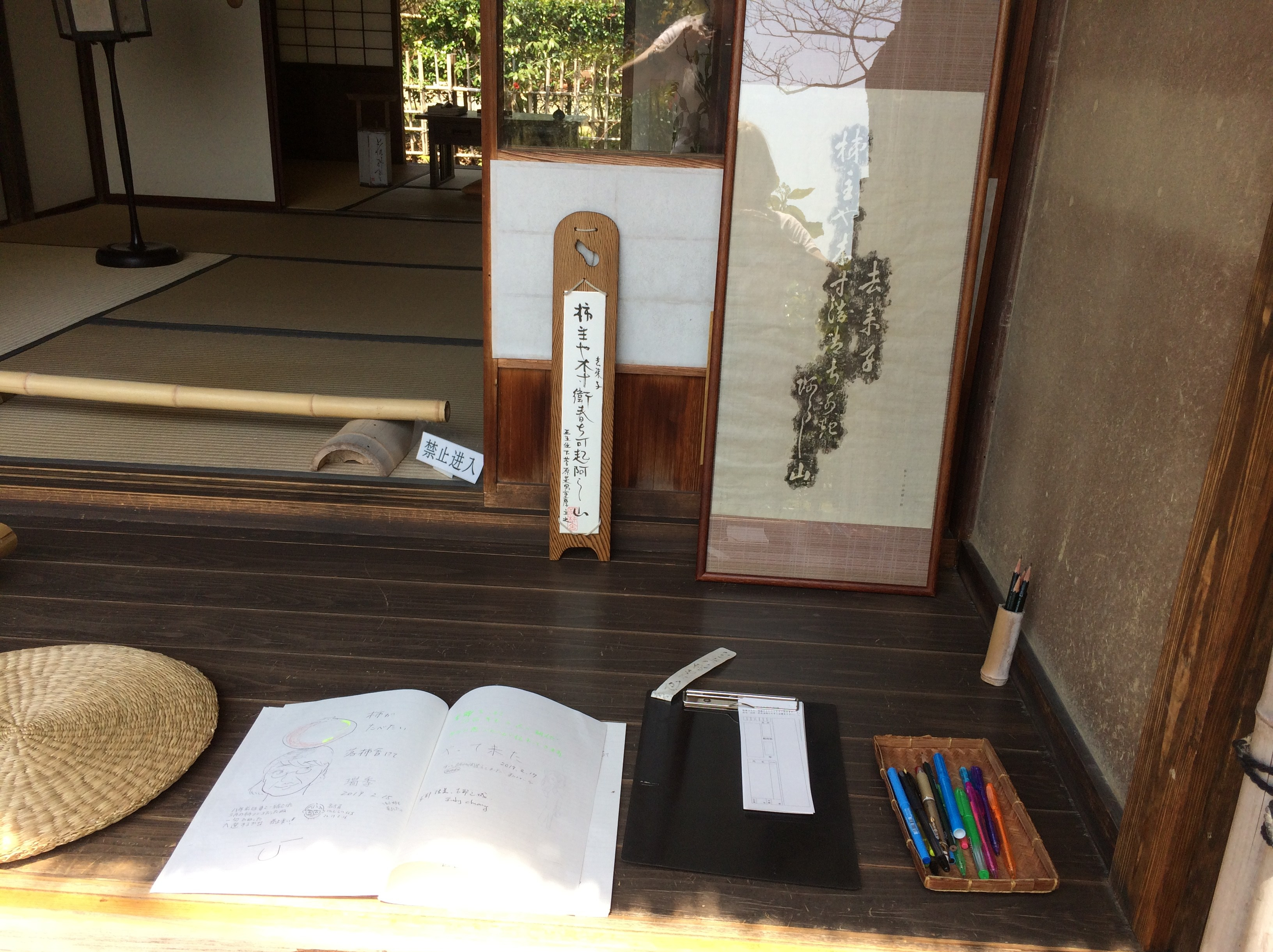
Finding myself mentally free from the entrapments of daily chores and routine, I felt creatively open to these unique sensory experiences.  In Kyoto I visited the 17th century home of Mukai Kyorai, the great haiku master Basho’s most famous disciple. I even dared to write a Sakura haiku and post it in the dedicated haiku letterbox.  The timing was serendipitous, as it was close to International Haiku Day.

img-2914.jpg
The home of Mukai Kyorai in Kyoto

Where I live in country Victoria we have a monthly poetry-reading afternoon, Chamber Poets.  In the very week when I was trudging through four inches of snow on a mountain pass on the ancient Nakasendo Way, my haiku, which seemed to spring effortlessly into my head day after day, were being read aloud at Chamber Poets as that important day was celebrated. The joy for me was in being able to relay that wondrous sense of place to my fellow poets so many thousands of kilometres away.

Earlier in March I had the privilege of being the featured poet at Chamber Poets.  Our meetings are held in the local RSL (Returned Servicemen’s League) Club.  I read a short memoir piece about my English grandfather’s experiences in the trenches as a 17-year-old foot soldier in World War 1, and I was both comforted and overwhelmed to share his history in that most appropriate of places.

Poetry and place; the words bind us, wherever we are.

French Film Festival: Non Fiction

“This film, directed by Olivier Assayas will have special appeal to writers. There are animated discussions about the nature of fiction, the future of print media — everyone huddled over wine and finger food. I felt very much at home!”
A recent film review from Little Smackerel, Elwood Writer Jennifer’s website:

Jennifer Bryce's avatarlittlesmackerel

non fiction 4

This film, directed by Olivier Assayas will have special appeal to writers. There are animated discussions about the nature of fiction, the future of print media — everyone huddled over wine and finger food. I felt very much at home!

Near the end of the film there is a reference to words from Giuseppe di Lampedusa’s The Leopard: Everything must change so that everything can stay the same. And indeed, this can be seen as the main premise of the film — most significantly as a response to discussions about the future of literature, but also as an underpinning to the lives of the main characters in the film. Should the publishing company focus on E-Books and audiobooks? There is an amusing suggestion that Juliette Binoche would be a good person to read a particular audiobook: Binoche plays the part of Selena in the film.

non fiction 2

Leonard , played by…

View original post 260 more words

Adelaide Festival Writers’ Week 2019 | Guest post by Tony Thomas

Many thanks to Tony Thomas for sharing his experience with us — Jennifer.

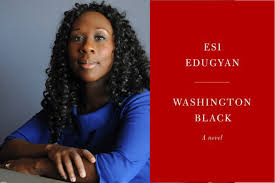
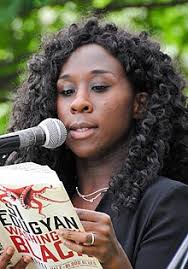
Sat 2 March 2019     Esi Edugyan interviewed by Geordie Williamson
esi edugyan 2

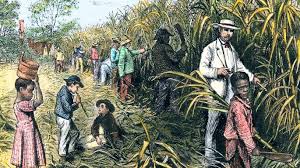
Esi Edugyan (pronounced Ed-oó-jun) is a Canadian writer of Ghanaian descent whose third novel, Washington Black, was shortlisted for the Man Booker Prize last year – and deservedly so I thought when I read it last year. She read to us the impressive opening pages where the protagonist, the child George Washington Black, a slave on a sugar plantation in 1830s Barbados, describes the arrival of his new master, the evil (it turns out) Erasmus Wilde, but here passing by dressed in splendid white, together with his brother Titch, a scientific experimenter, who becomes Wash’s mentor and protector.
esi edugyan 3

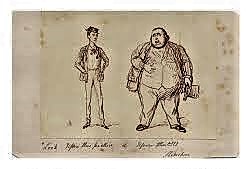
The first part of the book deals with the horrors of slavery, and these scenes are suitably horrific, but it’s the little details which strike us as absolutely real, such as the large mysterious covered object which Titch brings with him (it turns out to be an early airship) “bigger than the whipping stone” in the field. Esi said her idea for the novel started with an interest in the Tichborne Claimant. [Historical aside: Lady Tichborne refused to believe that her son and heir Roger had been lost at sea, and instead credited stories that he had been rescued and come to Australia. She advertised widely in Australian newspapers for news of him. A Wagga butcher eventually put up his hand as Roger, and Lady Tichborne asked her retired black servant, living in Sydney, to interview the claimant. The interview was inconclusive, but “Roger” was accepted as the heir, went to England and lived the good life for a while, until he was tried for perjury and imprisoned. Patrick White was also influenced by this story in his late novel, The Twyborn Affair, which however takes off on a very different tack.] Esi instead was fascinated by the life story of the interviewing servant, a former butler, who had been taken from the West Indies as a slave, had worked as a freeman for years as chief of a household, and whose life thus had been totally turned around in wholly unexpected circumstances. This then also became the core of Wash’s story in Washington Black.
esi edugyan 4 (2)

The Tichborne Affair

Esi said that in writing she always starts with character, that this is what fascinates her in the first place – but then of course, around the third draft she told us, the need for shape arises, a story has to take place as well, and in Wash’s case it was the story of a life being turned around completely. And not just one of being (eventually) released from slavery, but also a life of science, because Wash is endowed with a natural talent, a genius, for scientific drawing, especially of marine life, which comes naturally to him without training, and which becomes the most important part of his life. Science, she says, “was a way of engaging with the world without the need for solid relationships”. “Wash sees it as a benign equaliser”. And she wanted to focus on the idea of slavery not just as an unjust deprivation of freedom, not just lost bodies, but as something which causes a vast amount of lost potential, of which Wash’s genius can stand as example. Where are the great black scientists of the past, she asked: they hardly exist. So then her story developed into one of a restlessness of narrative, with many shifting locales after the slavery section at the opening, to the US, the far north in Nova Scotia, eventually to England, where Wash and his colleagues create the first aquarium and where in a shed in the gardens of a house, Wash has the first place that he can call home – very much a picaresque, she said in conclusion.

esi edugyan 1

Adelaide Writers’ Week 2019: the second day

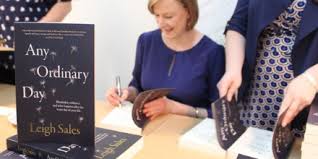
In spite of the heat, crowds of people attended the discussion with Leigh Sales, popular ABC presenter of The 7.30 Report, among other things. Leigh started by saying that while she conducted her interviews, so often with people who had been ‘blind-sided’ by some terrible event, she kept asking herself, when is something going to strike me? And it did, in 2014. The birth of her second child was highly traumatic. Leigh and the baby ended up in Intensive Care — she didn’t see the baby for 3 days — the baby contracted viral meningitis among other things. Then … her 2 year-old had some problems, Then … Leigh’s marriage of 20 years broke up. Leigh mentioned ‘doubt and dread’ — how rapidly life can change.

Adel Writers 2019 Leigh Sales 2

Leigh tried to gain control of her life by writing Any Ordinary Day. And she has realised that you can’t have complete control of your life. It isn’t a book about Leigh. She has interviewed a bunch of resilient survivors of all kinds of traumatic experiences. She has also looked at research into the brain, which shows that humans prefer certainty and predictability — we look for cause and effect. We think we can see cause and effect where there is none — because we want it so much.

Leigh spoke to the Vice Chancellor of Sydney university, to get a clear perspective of what to examine, where to go. He too had gone through a devastating personal experience. She spoke to people about the science of the brain and, although not a believer, to a priest. After speaking to these people she said she felt ‘strangely buoyed’.

There was discussion about how to interview people who have gone through severe trauma. Leigh said she tried not to cry in front of them — ‘it’s about them, not me’. There was mention of how important it is to talk to someone after they have been through some terrible ordeal — don’t make it worse by abandoning them, even if you think you don’t know what to say. There was mention of the different methods of interviewing on TV and for a book. On TV you have limited time — you interrupt to get to the point. When interviewing for a book it’s best just to ask a leading question and then let the interviewee talk: ‘How was that?’ rather than ‘that must have been awful’.

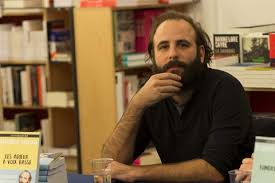
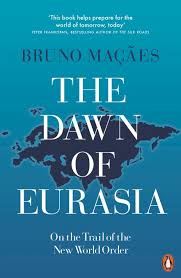
I hadn’t heard of Bruno Maçães. He was Portugal’s Minister for Europe. The government changed and he left the country (comments from the audience — a pity that more defeated ministers don’t do that!) and travelled — a long journey across Europe and Asia — he said you must go by road or train, not plane. You need to approach a city gradually. He started by saying that Australia could be the first Eurasian nation.

There was much discussion about what is the division between Europe and Asia. It has existed for centuries, yet it is artificial. Think of the difference between Japanese and Arabic people. Historically, Asia has been the ‘anti-Europe’. Does ‘Asia’ mean anything to Asians? Maçães described it as a ‘European myth’.

Adel Writers 2019 Bruno 2

There was discussion about how culture develops. A civilisation starts with trade and commerce. An infrastructure is built. Then culture develops.

Maçães now lives in Beijing. He said that arriving in Beijing is like arriving in the future. There is a love of technology and history suggests that technology is usually a basis for power — he reminded us of the superior technology of the 15th Century Portuguese, with their ship building industry. Maçães gave some examples of Beijing being like the future: you don’t use cash (we had come across this the previous evening at the Adelaide Festival Centre where we had to buy drinks with a card), there is now visual recognition at ATMs. New Chinese cities are being created. He described a gambling culture — your life is a gamble. According to Maçães, two big differences between China and Europe is that in China technology is embraced and English will not be the common language.

Adel Writers 2019 Bruno belt and road

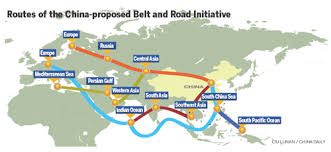
Maçães compared the world today to the world of the 19th Century — but this time the world will not be led by the West. He said, we are entering ‘a world without adult supervision’. Asked about climate change, Maçães suggested that within about 30 years there will be trade routes through the Arctic (I wondered what there might be to trade — what will we be eating?), Arctic beach resorts with 24 hour sunlight.

I left the talk more pessimistic than Maçães seemed to be.