Blog posts

Elwood Writers at Adelaide Writers’ Week 2019: the first day

An annual event for Elwood Writers is attendance at the Adelaide Writers’ Week.  We are all over here in Adelaide — the first day was one of  40 degree heat. We particularly enjoy this festival because of its location on the banks of the Torrens, the excellent choice of speakers and … most events are free.

Adel Writers 2019


The first event I attended was an interview with Emeritus Professor Gillian Triggs, former President of the Australian Human Rights and Equal Opportunity Commission, who has written a memoir, Speaking Up.  On the front cover, Geoffrey Robertson QC, Human Rights Barrister describes Gillian Triggs’ way of refuting her detractors as being ‘with reason not rancour’.  How true. Through heated, often mysogenistic battles, Professor Triggs manages a calm demeanour. She always refers to people with courtesy: Mr Turnbull, Mr Abbott, Mr Dutton … Most of the talk was about her work in human rights, but there was some mention of her early life. Until 12, she lived in England. It was just after World War II. She said that the end of the war and effects of the holocaust ‘seeped’ into her life. From this childhood she remembers ‘the smell of poverty’ — TB, coal, bombed out sites.

Adel Writers 2019 Gillian Triggs

Professor Gillian Triggs

After a career in Law — particularly International Law, the invitation to become President of the Human Rights Commission came from Nicola Roxon, who was Australia’s first female Attorney General and happened to have been a student of Gillian Triggs. There was discussion about the weakness of Australia’s constitution and the fact that Australia is the only Western democracy that doesn’t have a charter of human rights.  The constitution is more to do with state powers than matters such as freedom of speech. As a model of what could be, Gillian Triggs held up the example of Dr H.V. Evatt, who, as Chief Justice of the High Court and leader of the Australian Labor Party from 1951 to 1960, linked the importance of human rights to world peace. Gillian Triggs reminded us of the Magna Carta (1215): no man may be held without the judgement of his peers. Yet in Australia we have held people in detention without allowing them to go before a court.

There was discussion about the ‘cycle of poverty’ for women — the gender pay gap in Australia is increasing rather than decreasing. For example, at present women retire on 46% of the superannuation that men have. The figures don’t match our perception of ourselves. Gillian Triggs  suggested that her own generation of women ‘played the game’ — of getting well educated, turning up for work on time, nicely dressed … and consequently lost the ability to challenge the rules. The more privileged women must speak up for those ‘at the bottom of the pyramid’.

AdeL wRITERS 2019 2

Gillian Triggs also said that we will never be a coherent democracy unless we engage our indigenous people. She finds ‘identity politics’ an offensive term.

It was poignantly relevant to then attend a talk by Kassem Eid, whose identity card is marked XXX for nationality and he has a Protection Visa from Germany. Among other horrific experiences, Kassem Eid was involved in al-Assad’s  Sarin gas attack in Syria in 2013. He has written My Country: A Syrian Memory.


Adel Writers 2019 Kassem Eid

Kassem Eid

Kassem Eid was born a refugee in Syria — his family having been ‘kicked out’ of Palestine in 1948. He described Syria as a place where Muslims, Christians and Jews lived in harmony before the military coup. Kassem Eid learned his excellent English from reading The Reader’s Digest as a child. During the military regime, Eid’s family lived ‘under an iron curtain of fear’. Before the revolution it was Eid’s dream to leave Syria but afterwards he wanted to stay there, to make Syria a better place.

Children wrote ‘freedom’ on their school walls and were arrested and sexually abused. You are ‘safe’ if you do nothing, he said. If not, the punishment is unimaginable. By 2012 there was a siege around Kassem Eid’s town (near Damascus). Power was cut off. There was no medicine. ‘They bombed the shit out of us.’ Kassem Eid and his remaining friends and family survived by eating grass and a few olives. He described old Soviet/ Nazi tactics that were used. A lot of journalists lost their lives, he said, trying to send out images of what was actually happening. Then came what he called ‘Judgement Day’ in August 2013. He described a most terrifying and unimaginably horrific gas attack — everyone was suffocating — ‘something I cannot describe in words’. He was thought to be dead but he survived. He picked up a gun for the first time. He had not wanted to resort to violence.  ‘All I could think of was revenge.’ He ended by saying, ‘refugees love life — if not they wouldn’t go through such danger to get the minimal things a human being should have’. Having mentioned the pain of civil war where a friend fights a friend, he said, ‘get to know people that you think you hate’. I walked out holding back tears. Why hold them back?

After this devastating presentation  it was a relief to attend a session that focused on writing ‘what you know’, although it turned out that what the speakers ‘knew’ was still pretty shocking. Joelle Taylor, a poet from the UK has written Songs My Enemy Taught Me. She said that you ‘own those dark spaces’. Her ‘dark spaces’ were particularly about being sexually assaulted: ‘No one notices/ That the daughter is eating herself’. Joel helps others to write. Asked, can you write successfully about the banality of life, Joel said, ‘we need those stories, we need to find the beauty and poetry in going to the shops.

Before flaking in 40 degree heat, I attended Toni Jordan’s session on her latest novel The Fragments.


Adel Writers 2019 Toni Jordan

Toni Jordan said that for her, the hardest part of writing a book is getting the ‘idea’ — by this she meant, the idea that will spark off the story. For this book she was inspired by the publication of a second book by Harper Lee, more than fifty years after her first novel, To Kill a Mockingbird, which was highly acclaimed and won the Pulitzer Prize, and also by the fact that the identity of successful writer Elena Ferrante was revealed — she found Ferrante less interesting once she knew who she really was. Thus formed the idea of exploring author identity.

Toni Jordan doesn’t enjoy doing research for a book. She says she does as little as possible: ‘readers just need to feel as if they are there’. She in fact does what research is needed after writing a first draft of her book. Then she finds Trove very useful. She prefers not to have to move away from her desk.

Asked how she built up the ‘architecture’ of the book, Toni replied that she is a ‘knitter’ rather than a ‘quilter’. A knitter must start at the beginning (casting on) and continue, writing in the order that the book will be read. On the other hand, a ‘quilter’ would write ‘scenes’ and piece them together later.

Speaking of description (eg of surroundings) — ‘the particulars’ must always relate to the character . For example, in The Fragments, James lives in an old tumbledown Queenslander — this tells us a lot about him.

And, apart from Toni saying that when she’s finished one book she thinks she’ll never have another idea, there’s another book on the way — a clue to it is a tattoo on Toni’s arm — don’t worry, it’s nothing to do with tattooing (or dragons).


What’s occurring?

2018 was an industrious and fruitful year for Elwood Writers. Among other events, we hosted and thoroughly enjoyed presenting our work at our first public soiree, in August at St Kilda Library, and in November provided the material for the Armistice Day Centenary edition of Cover To Cover on Vision Australia Radio.

We’ve more exciting group projects planned for 2019, kicking off with an excursion to Adelaide for Writers’ Week in March. We’re thrilled to have been invited to collaborate with Tim McQueen and the team at Cover To Cover for another themed program on Vision Australia Radio, and will post more about that closer to the time. Also in the pipeline is another soiree, possibly towards the end of the year.

And of course our individual projects continue, with material regularly workshopped within our fortnightly group meetings.

With so much going on and coming up, from time to time it can be useful to consolidate and reflect. In that spirit, we’ve created a dedicated page on the website for recordings, mostly podcasts, of our group radio programs. All our programs for Cover To Cover beginning with Starting Over in January 2015 can now be accessed easily in one place, here, or by clicking on the link below:

We look forward to updating this podcasts page with the recording of 2019’s radio program later this year.

There’s much to look forward to, and always so much to write about. Here’s to a peaceful year; happy reading, listening, and writing.

Best wishes from Elwood Writers.

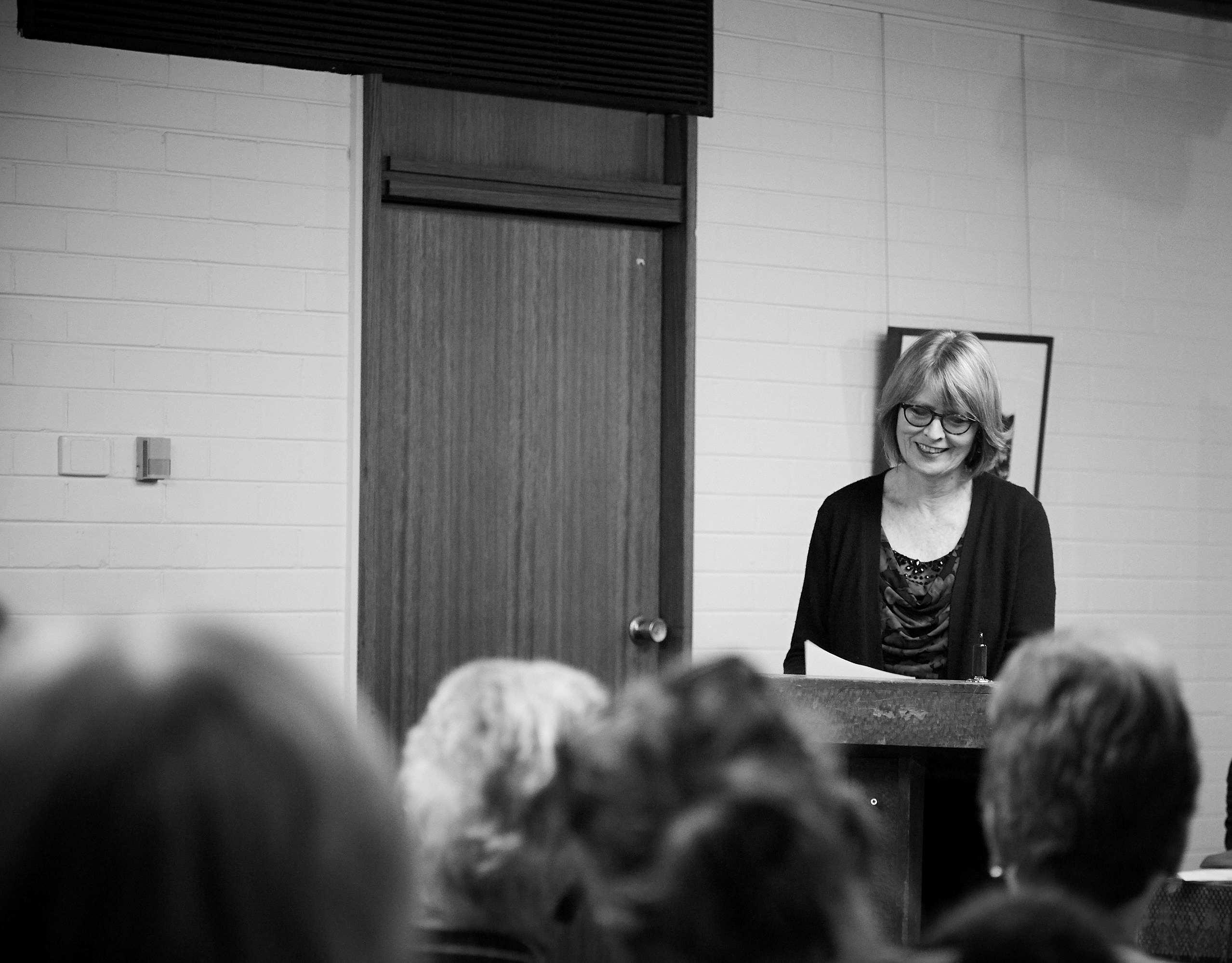
Winter 2018 Soiree | Margaret McCaffrey

Margaret’s notes on the Elwood Writers soiree held in August at St Kilda Library:

The Elwood Writers 2018 soiree was our third in a series of evening readings. The group’s first two events were held in a private home where we tested the performance waters with family and friends. This year we branched out a little, presenting at a local public venue and inviting a slightly wider audience.

The concept of a soiree is loosely based on the old-fashioned, European notion of a ‘salon’. People are invited to gather and enjoy themselves while being entertained with stories and musical interludes.

As my own work is mainly memoir and of a personal nature, I can find public readings to be challenging. But I have to be willing to open my soul, while protecting myself with the suited armour of a story and carefully crafted narrative.

Despite the challenges, however, in the long run I value the opportunity to leave my comfort zone (the support of my group and the patient listening of my partner), to spring into the exhilarating and expectant atmosphere of a live audience, whether this be with friends or strangers.

The audience’s response to us can be subtle. It might come in the form of a sigh of satisfaction or as a wave of relief (or even agitation) that ripples through the crowd. One might detect a murmur at the end of a story or poem, or a facial expression of pleasure or questioning. But despite any nervous apprehension on my part, I would not be willing to miss the experience for anything.


“… a sigh of satisfaction or as a wave of relief …”

The graduation from working solo to public performance is all in the path of the writer, I believe, where she must firm her step and ready herself to stride forth into the realm of the more global sphere.


All images HarrietClaire Photography

We acknowledge the traditional custodians of the lands on which we live and write, and we pay our respects to all elders past and present.

Winter 2018 Soiree | Helen McDonald

In August, Elwood Writers held its Winter 2018 Soiree at St Kilda Library in Melbourne. In this post, Helen McDonald describes the work she presented at the event.

2018_08_25-elwoodwriters_058.jpgIt takes time and a good deal of thought for Elwood Writers to arrange our program so that the literary readings are varied, complement each other and hopefully engage our audience. One of the things I enjoy most about our soirees is the range of genres covered, and not only hearing but delivering an interpretation of the pieces we have polished and workshopped in our group meetings.  Each member of Elwood Writers brings their own unique voice to the occasion across fiction, memoir, short story and creative non-fiction.

My own leanings are towards poetry and memoir, and in this, our first public performance, I read a selection of poems as well as haiku, a poetic form I‘m very much enjoying exploring.  Our appreciative audience were even subjected, from me, to a short analysis of what haiku is – and isn’t.

This time it was just as much a treat for us, as for the audience, to have Jenny’s chamber group providing musical interludes.  Duo Con Brio (two thirds of Trio Con Brio) chose Bach as the perfect accompaniment for the literary works, and the combined sounds of oboe and cello clearly delighted everyone.

St Kilda Library’s community room was the perfect venue for this intimate evening with friends, acquaintances and family, and we were so pleased to welcome members of Roomers, the City Of Port Phillip creative writing project.

It is such a rewarding experience to share our work and with each soiree I like to think we raise the bar just a little bit higher.


All images HarrietClaire Photography

We acknowledge the traditional custodians of the lands on which we live, work and learn, and we pay our respects to all elders past and present.


Armistice Day Centenary edition of Cover To Cover, podcast

A podcast of last week’s Armistice Day edition of Vision Australia Radio’s Cover To Cover is now available at the link below:

https://varadio.podbean.com/e/cover-to-cover-9th-november-2018/

The program, broadcast Friday 9 November and repeated Sunday 11 November, marks the hundred years since the end of the First World War, and features work from Elwood Writers.

We hope you enjoy listening to the program.


Cover To Cover is recorded in the studios of Vision Australia Radio in Melbourne.

Cover To Cover | Armistice Day Centenary

This Friday at 8:00 PM (AEST), Vision Australia Radio is broadcasting a special edition of Cover To Cover to mark the centenary of the end of the First World War. The entire program features work from the Elwood Writers.

Join us as Jennifer reads an extract from her novel set just after World War I, and a short story set in England at the time of the war. Helen reads ‘Reflections on My Grandpa’, a factual account of her grandfather’s experiences during the First World War and after. ‘Down to the Sea’ features Margaret’s memories of her grandfather, who had been a surgeon at Gallipoli. In Barry’s short story ‘Chloe’, a newly enlisted soldier is captivated by a portrait on the day he leaves home to serve overseas.

You can listen on the radio in Australia, or online from anywhere in the world. The program will be repeated on Sunday 11 November at 1:30 PM (AEST), and available shortly afterwards as a podcast. For listening and other information and streaming links, visit the Vision Australia Radio website, here.

We hope you can make it, and look forward to your company.


Cover To Cover is produced and presented by Tim McQueen in the studios of Vision Australia Radio in Melbourne.

THE CENTENARY OF THE END OF THE GREAT WAR — littlesmackerel

This recent post from Jennifer’s website includes details of a special Armistice Day edition of Cover To Cover on Vision Australia Radio. The program will feature work from Elwood Writers, and will be broadcast this Friday 9 November, repeated Sunday 11 November.


For much of my life World War I has hung in the dim past; a brown and white strip of celluloid showing huge, cumbersome guns, and soldiers marching through mud, sometimes at a pace speeded up by old movie film. People in my immediate family didn’t talk about it much, although my grandfather was there, […]

via THE CENTENARY OF THE END OF THE GREAT WAR — littlesmackerel

Sunday Radio — BARRY LEE THOMPSON

Just a reminder that if, like me, you weren’t able to tune into this week’s Cover To Cover from Vision Australia Radio on Friday evening, there’ll be another chance to catch the program this afternoon at 1:30PM (AEST). Join the team as they read stories by writers from all over the world, including The House […]

via Sunday Radio — BARRY LEE THOMPSON

We’ll be popping the kettle on and settling in for just under an hour of delightful storytelling on Vision Australia Radio’s Cover To Cover at 1.30 this afternoon. Included in today’s program, repeated from Friday, is Tim McQueen reading Barry’s short story The House In The Sky.

The House In The Sky | Vision Australia Radio

Barry has asked us to reblog a post about his short story The House In The Sky being read on Vision Australia Radio’s Cover To Cover program this Friday, repeated Sunday. All details are in the original post, here:

Barry Lee Thompson's avatarBarry Lee Thompson

My short story The House In The Sky will be read by Tim McQueen on Cover To Cover and broadcast on Vision Australia Radio this Friday, 2 November, at 8 PM (AEST), repeated Sunday 4 November at 1.30 PM (AEST).

Cover To Cover is produced and presented by Tim McQueen, and can be heard on the radio in Australia, or streamed online from anywhere in the world.

Radio frequency and other details and an online listening link can be found here:

https://radio.visionaustralia.org

The program will be available as a podcast shortly after broadcast.

Happy listening.

Barry

View original post

The Birthday | Vision Australia Radio

Here’s the podcast of the 5 October edition of Cover To Cover from Vision Australia Radio, featuring Mike Cannon reading Barry’s story The Birthday:

Barry Lee Thompson's avatarBarry Lee Thompson

My short story The Birthday was read recently on Vision Australia Radio’s weekly Cover To Cover literary program. The podcast of that week’s program is available here:

https://varadio.podbean.com/e/cover-to-cover-episode-232-5th-october-2018/

Cover To Cover is produced and presented by Tim McQueen. The Birthday was read by Mike Cannon.

View original post